Studies on Molecular Rotors – University of Silesia in Katowice


Gaining a better understanding of the motion of large systems is one of the most engaging scientific challenges of our time. The increasing structural complexity of newly synthesized chemical compounds translates into their ability to generate more and more complex molecular motions. This is a consequence of the perpetual searching for novel materials for increasingly demanding applications. As an example, organic materials for organic light-emitting diodes (OLEDs) can be given. Inspired by nature, chemists have long been interested in the design and synthesis of artificial molecular systems capable of precise mechanical operation and energy transfer. The common feature of mentioned systems is the secret of their structural and dynamic complexity, hidden in objects of considerable size and directional properties. Such materials are a collection of rigid π-conjugated heterocyclic units connected in a way that ensures the optimal path for electron transport. Considering such systems from the point of view of the dynamics raises many fundamental questions about the influence of anisotropy and large size on their motion most of which have been never studied before. To explore them, we need extraordinary tools and pioneering solutions. Therefore, we have proposed a new concept of sizable glass-forming materials. The correlated dynamics of several moving parts within a single molecule make sizable systems a platform of materials providing an intriguing starting point for future studies of such intricate objects. Fluorene-based compounds combining different π-conjugated building blocks are attractive candidates for various light-emitting applications, e.g. in OLEDs. A growing interest in motion capture, soft robotics, and wearable medical technologies has stimulated interest in flexible electronic materials. Sizable glass-formers are a promising class of materials that can meet future soft-material requirements.
Understanding the Motion of Large Glass-Forming Molecules
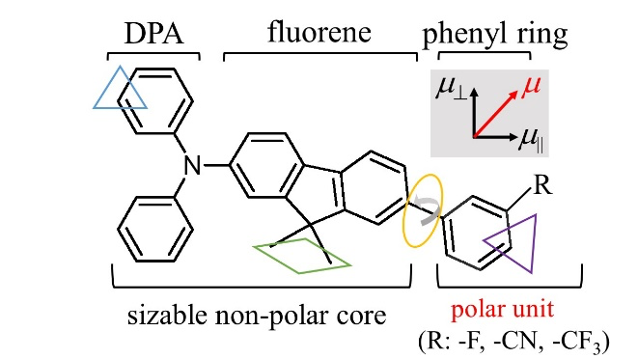
The dynamics of molecular reorientation play an important role in many classes of materials, determining their physical and mechanical properties, underlying applications, and thus influencing materials science and development. The consideration of large and anisotropic systems with significant moments of inertia leads to some questions regarding their rotational dynamics, most of which have been never investigated before. To address these fundamental issues, we proposed a new class of sizable glass-forming materials with peculiar relaxation properties revealed in dielectric relaxation studies. The concept of sizable glass-forming molecules (molar masses of approx. 600 g/mol, number of atoms > 80), concerns material being a collection of rigid or semi-rigid planar frameworks creating molecular cores functionalized with flexible chains and linked to small polar units. The main goal of the project is to examine how factors such as size, shape anisotropy, structural complexity, orientation, and value of dipole moment influence reorientation dynamics of sizable glass-forming molecules probed by broadband dielectric spectroscopy (BDS).
In the project, we study sizable molecules in which the dipole moment is distinctly oriented. It is realized by judicious chemical modifications of the position of the polar group in the non-polar sizable core (see Fig. 1). As a result, we obtain materials in which the particular components of dipole moment have different magnitudes. In dielectric spectroscopy, the dipoles play a pivotal role as molecular reorientation probes. It is unclear how the individual components of the dipole moment sense the molecular motions in anisotropic and large glass-forming molecules with partially rigid and planar cores. Consequently, the overall picture of molecule reorientation provided by dielectric measurements remains a puzzle and needs pioneer examinations.
Our innovative approach, based on systematic dielectric studies of sizable molecules differently labeled with a dipole, will allow us to tackle the previously unknown aspects related to the impact of large size (significant moment of inertia) and anisotropy on the reorientation of sizable molecules probed by BDS, and allow us to explain to what extent the properties of a probe (dipole) govern the overall picture of their reorientation dynamics. Outcomes of the planned research will have a high impact on the understanding of the nature of many fundamental processes linked with the supercooled state. These cognitively ground-breaking issues will be discussed in the context of a newly constituted class of glass-forming materials strengthening the foundation of proposed classification. A pioneering effect of the project may be related to the direction of dielectric research into completely new areas of practical implementation related to the selective study of the motion of dipole-labeled molecular fragments. This is an important step in understanding the motions of complex molecular systems using the dielectric method.
What have we discovered so far?
Our research has revealed that large, anisotropic molecules forming glassy states behave in ways that go far beyond what is known for conventional glass-forming systems.
We have shown that molecular shape plays a crucial role in controlling dynamics. Even subtle structural differences can dramatically alter how molecules reorient, both at ambient and high pressure (article link).
We sought to explain the strong pressure sensitivity of their molecular dynamics in the supercooled liquid state and found, surprisingly, that it cannot be attributed mainly to density changes (article link).
One of our key findings is that these anisotropic and sizable molecules exhibit a dual dynamic nature, challenging classical relations such as the Debye-Stokes-Einstein law (article link). This indicates that their motion cannot be described by simple, universal rules known from smaller systems.
We have also uncovered how cooperative dynamics emerges and evolves in liquids composed of anisotropic molecules, providing new insight into the fundamental nature of the glass transition (article link).
Importantly, we developed a novel concept of using internal molecular motions as local probes (article link). By analyzing secondary relaxations, we showed that polar rotating parts of a molecule can “sense” their surroundings, allowing us to extract detailed information about molecular environments inaccessible in simpler materials.
These studies revealed the potential of sizable molecules as molecular rotors (check here), since fragments of these large molecules can rotate even in the crystalline state. We showed that small chemical modifications can switch molecular rotation from fast to slow, leaving clear fingerprints in dielectric spectra (article link). We also identified two distinct patterns of dielectric response in polar molecular rotors and demonstrated how subtle chemical changes control rotational performance at the molecular level.
Moreover, by manipulating crystal polymorphs, we demonstrated that it is possible to engineer rotational dynamics in the solid state, opening new pathways in amphidynamic crystal technology, which uses the phenomenon of crystal polymorphism to design crystals with tailored internal rotational dynamics (article link).
Altogether, our results show thatsizable glass-forming molecules constitute a new and unique class of materials with complex, multi-scale dynamics. These findings not only deepen our understanding of glass-forming matter, but alsoopen new directions for studying and controlling molecular motion in advanced functional systems.